Showing posts with label book arts. Show all posts

Wednesday, July 27, 2016

20/20 Vision


The San Francisco Center for the Book celebrates its first 20 years by looking ahead. 20/20 Vision introduces 20 emerging book artists from around the country, representing a diverse generation that will help define, and redefine, the artist's book in decades to come.

Opening Reception: July 30, 2016 from 6–8 pm
375 Rhode Island Street, San Francisco

Wednesday, April 6, 2016

Turning scraps into stories ...


Story Box: Creating Narrative with Relief Collage is happening at San Francisco Center for the Book next Saturday, April 16! We'll be making story boxes, shallow boxes with partitions that tell three-panel stories using 3-D collage (think Joseph Cornell!). Whether or not you're new to the book arts, if you're interested in boxmaking, visual narrative, sequential art, or collage, this workshop will be a lot of fun! Click HERE to register.

Monday, March 14, 2016

Build a Story Box at SFCB this April 16

This April 16, I'll be teaching Story Box: Creating Narrative with Relief Collage, a daylong workshop at San Francisco Center for the Book. In this workshop, we'll use bookboard to build a shallow box with three collaged compartments. Participants will receive instruction in 3D collage, layout, and sequence, and will leave with the fundamentals of building, covering, and dimensionally decorating a compartmented box. This will be a a lot of fun—learn more HERE!

Saturday, May 2, 2015

UICB MFA Group Show

The 2015 graduating MFA's at the UI Center for the Book are currently showing selections from our thesis work at the K.K. Merker Gallery in the basement of North Hall. I'm proud to be a part of it—there's some pretty fantastic work by Maggie Heineman, Alexandra Janezic, Andrea Kohashi, Candida Pagan, Steph Rue, Leslie Smith, and Kalmia Strong. The reception is this Friday, May 8th from 4–6 pm.

Tuesday, November 12, 2013

Writing for Visual & Material Genres

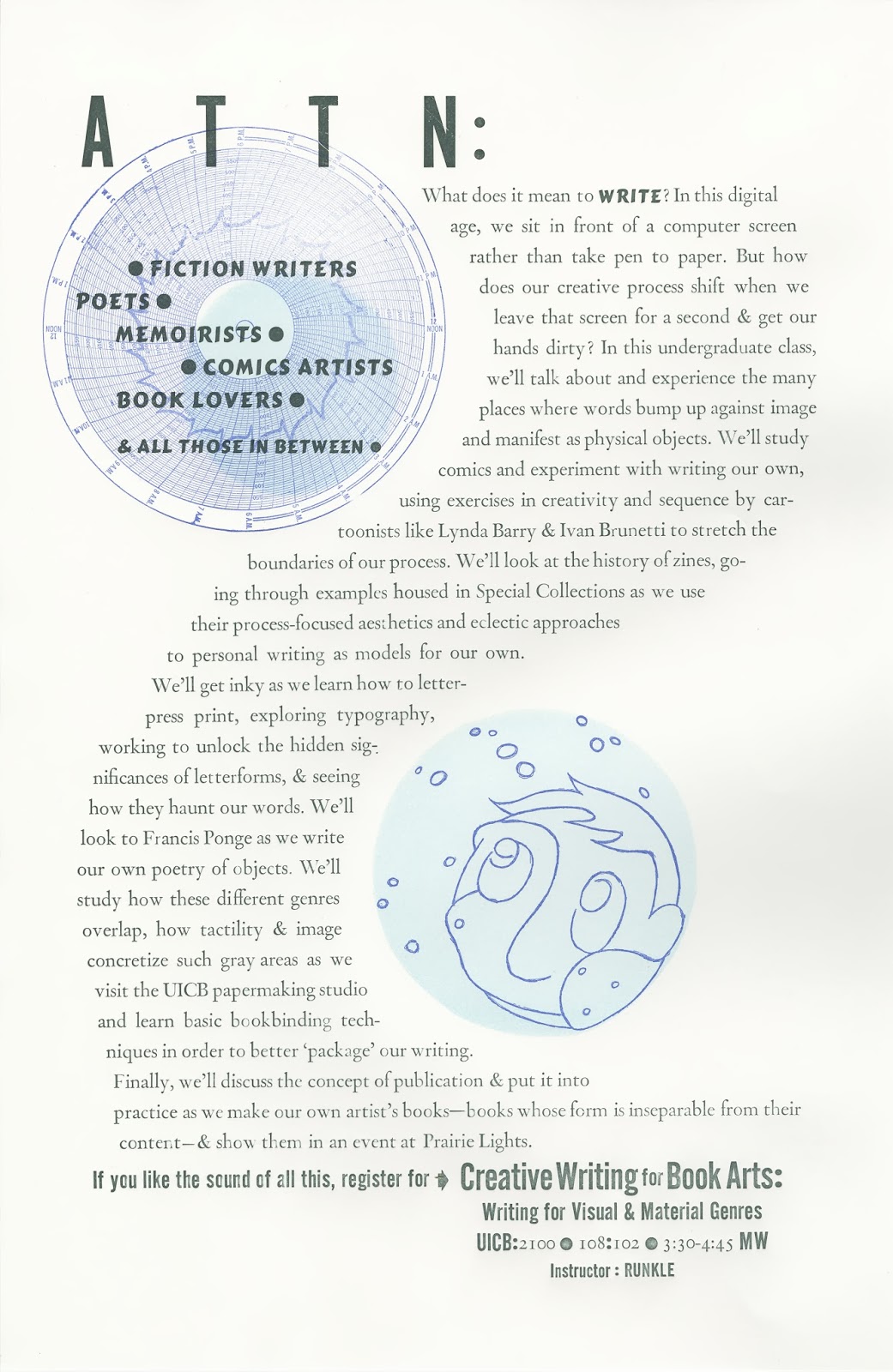
I'm really excited to teach a class at the UI Center for the Book this Spring: Creative Writing for Book Arts: Writing for Visual & Material Genres. The interdisciplinary class is for both writers and visual artists, and asks how material and visual forms present, comment on, and/or merge with textual content. In what ways do we balance readability and individual expression when writing and designing published forms? The class will emphasize tactility and mark making, looking at literature as a physical process, as well as a material product. It will explore a variety of book-related genres and media, including broadsides, chapbooks, concrete poetry, comics, zines, and artist’s books.


Above is a poster I letterpress printed to promote the class. I used craft foam, a scratch-negative photopolymer plate, a found copperplate block, and metal type (see the lockup below, thanks to Pamela Olson!).


Monday, November 4, 2013

The Iowa Working Group Archives

I've been working on archives for the Iowa Working Group. The IWG has now hosted a year's worth of book-art-focused presentations followed by casual discussion, and I wanted to make sure they were documented. Check out the latest entry for October: Candice Wuehle and Patrick Reed's The Sacrebleu Defense, which was a performative excerpt variation from their in-progress chapbook. The next IWG meeting will take place Friday, Nov 15, and will feature sneak previews from Iowa students who plan on presenting at the upcoming College Book Art Association conference. To find out more details, sign up for the IWG listserv by emailing iowaworkinggroup at gmail dot com.

Sunday, July 21, 2013

More Artist Book Sketches: Pedestrianica

I made more artist book sketches by incorporating a Baudrillard quote into two different book structures (to learn more about this Artist Book class assignment, read this post). 


I was in the middle of returning to my Letter from Pedestrianica posts, working to adapt them into an essay that, because of the way a pedestrian interacts with a cityscape, seemed apt to take place in an artist book format. The Baudrillard quote—"When your driver's license goes, so does your identity"—was in my notebook and haunting me, and I figured playing around with it would help me understand the physical shape this essay might take.


In both books I used yellow-orange—one of my favorite colorsappropriate because of its yield-sign solidarity, convenient because it meant I could utilize recycled manila envelopes. In both sketches, I used old RUNX TALES drawings of my face to represent the identity a driver's license photo attempts to capture. The paradox in both sketches is that, as the reader moves through them, the face becomes less obscured—in the first, through transitioning from the pedestrian icon's head to a more detailed face (before ending in a festive image of violence); in the second, through the subtraction of strips of paper.


I'm still thinking about how these structures and concepts could be worked into a book designed to contain (and interact with) a longer essay. 

Friday, June 22, 2012

The Taco Group now posted!

I finally posted my short story "The Taco Group," along with all its bells and whistles from a performance I gave last year at Headlands Center for the Arts. The piece tells of infighting among the members of a sinister kaffeeklatsch, a group whose goal is to build a utopia out of the remnants of the post-functional city in which they live. As I wrote the story, I realized my aim was similar to that of my characters': I was doing a lot of scavenging in an attempt to make something perfect. I processed this a little in an artist's statement, and used recycled materials to construct slides of the utopian city's streets, as well as fixings for a taco buffet. I also letterpress printed the Taco Group's progress report. All these elements came together to form a not-quite-reading/not-quite-installation. Is it something we could call a book? See for yourself!

Wednesday, February 22, 2012

History of the Book.3

Continued from Part 1 and Part 2

For various reasons, that “summer trip to the West Coast” has now lasted seven years. I’m surprised those books I made years ago have survived like they have, considering how much I did not know what I was doing. Of course, it didn’t hurt that I was salvaging from more solidly assembled structures. But still.


Which leads me back to that space between the second and third dimensions, and the challenge of addressing it in a venue as seemingly flat as, say, a blog. Because this is where I’ve been channeling that energy—once reserved for dissembling and mashing up longer-form, structural narratives—into compressed one- and two-shot collages.* There are a couple of reasons for this:

1. My attention span has waned, what with the Internet and all that. I try to fight it in some arenas, but since the blog is a medium suited to quick little glimpses, I figure this is one battle not to pick. Also, I finished writing a novel last year, and since then, most things I do—whether writing (flash fiction) or art (collage as blog posts)—want to be microcosmic.

2. Binding kind of stresses me out. I love the results: a sturdiness that allows for shifts as you turn the page. But there’s a commitment there that’s scary. Besides, I’ve never really gotten the math down.

So there is a kind of liberation in the blogged collages, in that they are both low commitment and ephemeral. I can knock one out in an evening if I want, and I don’t have to worry about it lasting. Once I’ve placed it in the scanner, and made sure any wayward details are straightened, I can shove it in a milk crate and forget about it. If for some reason in the future, I try and dig it back out to hang on a wall, and it crumbles in my hands, I’m okay with that: I’ve prepared myself. Anything that survives is—if not a miracle—a bonus.


Because all that matters here is the scan, those few crucial seconds after the lid closes when the light cranks by. And here’s where it’s hard not to think of the scanner as a book. Its design seems modeled after the codex, doesn’t it? And it “reads” the things you put inside it, a fleeting act that ends up feeling kind of like a fossil record. A mummification in the ether. An anti-binding, maybe? Or at least a binding that takes place in some unnamed dimension.

There is a whole genre of scanner art, I’ve discovered, called scanography (scannography) or scanner photography—where images use the technology of the scanner in their composition. Just as zine aesthetics (and Xerox art) came about through the advent of the photocopier, the accessibility of the scanner has created an aesthetic of its own.


One thing I’ve thought about is how zine aesthetics changed a lot when photocopiers digitized and Kinko’s became harder to scam. As zine makers have focused more on using pre-Xerox printing techniques, such as silkscreen and letterpress, there seems to be less of an emphasis on the textural nature of collage. This makes me wonder about the future of the scanner: what might be marketed to take its place? That’s why it’s good, I guess, that I’m trying to become less reliant on—and take take less comfort in—technologies that are ultimately temporary.

The book, though, is not one of those technologies—despite the hand wringing that’s happening with the spread of ebooks. The physical book is becoming increasingly fetishized as it threatens to disappear, and with it, I think, the sense of touch. Although all our coveted devices are sold to us by boasting features such as touchpads and touchscreens, once we step away for a second, we see how flat these things really are. And what about CGI? These “3D” creations would deflate with a fart if you tried to grasp them. A simple line drawing is more dimensional than CGI's special effect placebos. So, yeah, there's my side-rant, and I guess my point is this: there is a longing, I think, beneath all this prognosed dematerialization, for something you can hold in your hands. And that longing is here to stay.

So the neglect I’ve been giving bookmaking lately is temporary. I'll return to it, I promise myself, after I tire of the fun I'm having completing things that can remain incomplete. In the meantime, I like the challenge of trying to bring tactility—or at least the illusion of it—to the often textureless realm of the Internet. I also like the freedom of being able to incorporate three-dimensional elements that I couldn’t in a book whose pages must ultimately lie flat (the scanner's fine with not closing all the way). Who knows? Maybe one day, when blogs are obsolete, I can come full circle and take on the challenge of translating this blog's content into a physical book. How's that for completion?

*I’ve only made a couple altered books since I’ve been on the West Coast: Tarpaulin Kingdom and The Witch, a Lemondrop Wedged Firmly In Her Cheek, Begins Her Evening Prayers.

Monday, February 20, 2012

History of the Book.2

Continued from History of the Book.1


After that bleakest of Bellingham winters, I moved to New Orleans, into a Mid-City warehouse where all the rooms were only half built. On more than one level, I was entering a place about which I knew very little. That’s the thing about picking up someone else’s old book, right? Sometimes there is marginalia, which gives you a peek at the lens through which past owners have read it. Other times, a book has been so cared for, you’d swear it had never been opened. Either way, there’s a deliberate ignorance in choosing to destroy a book—even with the intention of giving it new life.

The few windows in the warehouse were new, recently installed by my roommates, my friends. I even put one in myself—that soul-sucking sound of the Sawzall, then the light coming in, at last—and there were vines on the other side, stretching out across the corrugated roof next door. Beyond that, graveyards, which sprawled in almost every direction.

There seemed to be a few ghosts in this building, too, which for myself, mostly manifested themselves in dreams: My dad and I, putty knives in hand, urgently trying to repair a warehouse wall. Inside the wall, there were ghosts, increasing in sinister pressure, always on the verge of leaking outwhich they did, at last, with the sound of a hellish scream. When they escaped, it meant certain deathone of the few times a dream allowed me to die.


These are the sorts of things that happen, according to Wikipedia, when you alter a book: “cuts, tears, glues, burns, folds, paints, adds to, collages, re-binds, gold-leafs, creates pop-ups, drills, bolts, and/or beribbons …” And this, I think, is what makes it such an appealing art for for me: its interdimensionality. On one level, a book (and when I say book, I mean the traditional non-e sense) strives to lay flat; it purports to be there to display a readable page. Yet the pages refuse to stay constrained to the second dimension: they demand to be touched, to be lifted and turned, to rise toward the reader and be sculptural, to inhabit an infinite number of angles before again pretending to be flat. And with altered books, all those add-to's and cuts only complicate the interdimensional confusion.


In one of those warehouse walls I built—this is in waking life now—I installed dioramas, which merged scenes of caveman with roses and chunks of polished glass I’d found on the beaches of Bellingham Bay. Remember: to obtain those pictures of cavemen was barbaric. New Orleans, too, had a good source of cheap books: a large Thrift City only blocks from my new home. Soon, we at the warehouse began hosting art shows, which gave me deadlines, which inspired me to create (re-create?) more books. One of those art shows, parasite-themed, inspired Tiny Monuments (They start eating you long before you're dead). I still have Tiny Monuments today thanks to Michelle Embree, who talks about its rescue over at her blog.


Stories change. Sometimes they merge and sometimes they haunt one another. They’re taken apart and re-ordered. New Orleans was where I first finally came out of the closet, a moment that had been building up for way too long. Once that ghost was released, I tried to ride with it, and was manic about it in the shyest sort of way: I wrote all the necessary people, and told the ones who I most hoped would tell everyone else. Then returned to the West Coast for what I thought was a summer trip. While I was there, though, my roommates all fled as well, and the warehouse was evicted and then looted. This was all several years before Katrina, so who knows what’s happened since, with those less than watertight windows, and those fragile dioramas which probably only weakened the walls. I have not been back to where that warehouse stood; I guess my ignorance has remained deliberate. 

Click here for Part 3!

Friday, February 17, 2012

History of the Book.1

I first started making altered books during a cold, gray winter in Bellingham. The town of Bellingham is as northwest as you can get without stepping into Canada, so there you go: imagine the bleakness. My room was a sublet and filled with objects that weren’t my own. There was a shelf with some decorative bones, and one day I found a femur in my bed. Soon after, my pillow vanished for several days before reappearing. I thought maybe I had a poltergeist. Also, though, I was smoking a lot of weed.

I’d found a wallet in a grocery store parking lot and quickly spent the ten-dollar bill inside it. I then failed to return the wallet, and it sat in that room for way too long. I looked at it sometimes, peripherally, and wondered if it was cursed. It held pictures of its owner, who was ex-military, posing with muscles flexed. He looked scary, and grew more so the longer I waited. The wallet also held a membership card to the food co-op, which I later realized was my ticket out of showing up at his front door. When I handed it to the hippies at the co-op’s counter, they made some magical motions with their hands and wished me good karma.

Still, there was something sinister beyond that room: the whole house was decorated a bit like The Shining. The roommates were each on their own very different trip: The eerily silent hardcore dude. The good-natured Ren-fairer who made chain mail.  The aspiring 1950s hostess who had taken riot-grrrl irony way to seriously. Each of these people had an unreadable interior. Each of them deserves a much longer character study that would fast veer into fiction. Each could have easily been fucking with me.


Anyway, this was the setting where I first started taking books apart and putting them back together. It’s funny, now that I write it out like this, because it seems like such a reflection of my surroundings at that point. Things were showing up where they didn’t belong. Problems were being transmuted rather than solved. And on some level, the whole situation echoed what was going on in my head. I was still in the closet then, and I think some obscure agent of my brain must have been devising an escape plan. Experimenting with new narratives—pieced together from old ones—seems now like an apt area in which to be working.


On a more practical level, materials were abundant. There were bottomless free boxes outside the public library and Michael’s Books. Aladdin’s Antiques had old photographs for a nickel (this was back before such things became an art-student commodity). I couldn’t help but take these treasures home: well-worn paperback covers with scenes of interplanetary colonization; fortuitous doubles of women holding cats; dreamlike photos of laser projections on a canyon wall. Themes would arise in the midst of digging, then morph or develop as I spread my finds out on that weird little room’s shag carpet. One of the books I made, I named Recipes: Incubus, Succubus, Poltergeist.* 


I’m trying to remember now how I came to feel like I knew what I was doing. My bindings were simplistic and intuitive, mostly figured out from having learned to sew patches onto things. The collage elements I’d absorbed, I think, from album art, as well as from exchanging mail art and from reading and making zines. The biggest specific influence I can remember is my friend, Stephanie Pierce, who I’d spent the previous year palling around with in Asheville, North Carolina. When she’d showed me the books she made out of trash, something clicked.


That’s why it’s weird, now, when I look at the Wikipedia page for altered books: a disproportionate number of the artists listed there are from Washington state. So maybe the geist I was being haunted by wasn’t so much polter as zeit. This, I should remind you, was a time before the Internet, and I was oblivious. It’s hard not to feel nostalgic, though, as I sit here, a glassy-eyed Internet addict. Like I had access to something more unquantifiable then. Was this chance? I think it was. Chance is when one image just happens to lay on another. Thank god for those last oblivious days of chance.

Click here for Part 2!

*An unconsciously perfect title. The incubi, now that I think of it, were making themselves just as known as the poltergeist.  My friend, who I had an unacknowledged crush on, spent the night on the living room couch and complained of experiencing sleep paralysis—the ghost that sits on your chest. But in my memory now, I clearly had the same experience myself. I was sleeping on the couch (But why? Was I trying to escape the ghost in my room?), and awoke feeling terrified and unable to move. What makes this memory so vivid, though, is that it’s connected to another one: hearing the eerily silent hardcore dude come home drunk and talk more than I’d ever thought possible. He and his friend laughed as they took some meat out of the freezer and tried to cook it. I wonder now: is this something I really experienced? I’ve never had sleep paralysis anywhere else—although my friend, who was asthmatic, had. There is an image I used in Recipes: Incubus, Succubus, Poltergeist, that when I think of it now, was a signpost on my way out of the closet: a naked man asleep, his cock and balls on display. I don’t remember now where I found this picture, but there was power in it—a pre-Internet kind of power, right? I had barely missed the Mukilteo Fairies when I moved to Bellingham. 

Wednesday, December 28, 2011

Interview with Katarzyna Bazarnik & Zenon Fajfer


Katarzyna Bazarnik and Zenon Fajfer are a Krakow-based duo that coined the term liberature, a literary genre that focuses on the physical form of a text. “The term we coined for this kind of writing,” the couple says, “points out that it is nothing else but literature in the form of the book (one meaning of Latin liber), liberated from any literary and editorial conventions (another meaning of Latin liber)—it is a kind of ‘book in freedom’.” Baxarnik and Fajfer have released a series of liberatic titles under the Liberatura imprint for Korporacja Ha!art publishing house. They recently toured the US, where they participated in a “Liberty Poem” at an Occupy Wall Street action and visited Mills College here in Oakland as artists in residence. They graciously answered some questions for me this month, which are posted at San Francisco Center for the Book’s blog:

Wednesday, November 30, 2011

Interview with Myrtle Von Damitz!

I've started blogging for the San Francisco Center for the Book, and my first post is an interview with Myrtle Von Damitz, III. Myrtle is a New Orleans artist who founded the annual book arts exhibition, Babylon Lexicon, in 1999. She goes into the history and evolution of the exhibition, including what makes it unique to NOLA, as well as some context of the city's underground literary and journalistic history.