 The Drift Plain Collective is representing once again this weekend, as they bring a bunch of chapbooks, zines, broadsides, and prints to the 2015 Vancouver Art/Book Fair. They'll have copies of RUNX TALES and Catholics on hand, as well as some spectacular books and ephemera by Elizabeth Boyne, Karen Carcia, Cody Gieselman, Kimberly Maher, Elizabeth Munger, Kalmia Strong, and more. A culmination of Vancouver's Artists' Book Week, the Vancouver Art/Book Fair is hosted October 17–18 by Project Space, and is free and open to the public.

Showing posts with label zines. Show all posts
Showing posts with label zines. Show all posts
Thursday, October 15, 2015
DPC @ VA/BF
The Drift Plain Collective is representing once again this weekend, as they bring a bunch of chapbooks, zines, broadsides, and prints to the 2015 Vancouver Art/Book Fair. They'll have copies of RUNX TALES and Catholics on hand, as well as some spectacular books and ephemera by Elizabeth Boyne, Karen Carcia, Cody Gieselman, Kimberly Maher, Elizabeth Munger, Kalmia Strong, and more. A culmination of Vancouver's Artists' Book Week, the Vancouver Art/Book Fair is hosted October 17–18 by Project Space, and is free and open to the public.

Thursday, September 24, 2015
Drift Plain Collective at St. Louis Small Press Expo

The Drift Plain Collective cooperatively distributes hand-crafted artist's books, chapbooks, zines, broadsides, and prints. Our offerings emphasize collaboration and innovative modes of storytelling that take form and materials as a crucial component.
Thursday, September 10, 2015
Fragmentation is the rule

But still, they remain separate, text on one page, image on another. There is a power, though, in turning that page and seeing the other side of the coin. Haptic agency connects two divergent ways of receiving information. My zine-making background causes me to privilege the chimerical results of collage: no matter how certain it seems that two scraps belong together, tactile cues identify them as separate entities. The places in between (between pages, between scraps) are where things get really exciting, where you can peer into the gaps between artifact and story. Fragmentation is the rule—a dictate that’s not so radical, really: the separation of text and image characterizes what is often dismissed as that most conventional genre, the livre d’artiste.

 The book's prose sections are the origin points for exploring a range of subjects including Catholic-Masonic tensions, the fervency of converts, the legacy of the Legion of Decency, and the spiritual significance of revelatory shrouds. They relate my religious upbringing as they join with the book’s images to braid several themes: Church history, pre-Christian mythology, and the places where such spiritualities resonate with twentieth-century pop culture. In Catholics, text and image, the sacred and profane, the humorous and tragic, the zine and literary fine-press all end up as strange bedfellows in desperate need of confession.
You can learn more about Catholics here!
Thursday, August 20, 2015
State of the Art

I finally got around to updating my artist statement! The new version talks more about my efforts in the past few years to synthesize several different modes of working: letterpress typography, comics, zines, collage, and illustration. I copied it below—or you can click here to read it on my website.
Although I work in several different media, I see them all as modes of writing. And when I say writing, I mean the building of narratives through assemblage of fragments. And when I say fragments, I mean the physical, the detritus that combines to form a collage. But I also mean the conceptual, the attempted capture of a thought on a scrap of paper to be put in a drawer for later. When coming across that scrap again, how has its function evolved? It is a contextual challenge. What kind of story does this thought want to build? Or rather what kind of story will welcome it? Or rather what kind of story will, through sheer juxtapositional force, accept this thought against better judgment and, as result of such counter-intuitiveness, flourish?
Because this process involves layering, tactility is important. Also, depth, or rather the illusion of depth, or rather the spaces that confuse dimensions. The book form, then, is ideal: the second dimension gives way to the third with each turn of the page, and the reader’s experience from start to finish takes place in the temporal fourth. And because my process relies on the scraps of narratives past (as is inherent in the process of collaging, of constructing memoir, of altering books), a tension forms between the transitory and the permanent.
Things begin to feel cluttered, though, don’t they? Thus the containment and constraint of prose. There are endless possibilities offered by the interaction of text and image, yet still those typographic fields created by unbroken word-flow keep calling me. And while bearing in mind the sculptural and temporal effects of a book’s structure, I want to remember a parallel power it holds: the meditative and transportive experience a reader undergoes when surrendering to story. A power dependent on content more than form (as long as the typography has the grace to let you past), it’s one I’m intent on investigating further, while also exploring the many kinds of conversations a text block can have with an image, both within a book’s pages and beyond. I was instrumental in the commercial book design of The Story of How All Animals Are Equal & Other Tales (Brooklyn Arts Press, 2014), while also creating companion images for many of the collection’s stories. Taking the form of collages and letterpress-printed broadsides, these visual pieces partner with the written word, breaking their trance (or perhaps re-casting it) to build extra-textual narratives. And now things grow cluttered again.
I’m digging through drawers of scraps, though—it’s unavoidable. And as I dig, I pull from multiple mediums and genres: comics, zines, literary fine press printing, collage, memoir, fiction, illustration. The places in between these are where things get really exciting, where we see the infinite possibilities of what can happen in the gaps between artifact and story. Synthesis is an ongoing challenge. What formula of mortar will make things cohere (even if just barely)? I’m currently researching historical, commercially motivated, collaborative modes of text + image book production, such as medieval scriptoria and twentieth-century mainstream American comics publishers. As I work to integrate a wide variety of techniques and traditions, I draw inspiration from circumstances where a number of artists (copyists, illuminators, rubricators, pencillers, inkers, letterers, colorists) have allied to do the same.
Catholics is an artist’s book, a limited-edition memoir that makes use of illustration, collage, and letterpress-printed typography to explore the psychic cathedral built by my Catholic traditionalist upbringing. The Hitch: An Agamist Manifesto is an ongoing wedding-themed project that will eventually consist of ten chapbooks of various literary genres creating a variety of visual, tactile, and intertextual patterns. I think of both, by default, as graphic novels, despite their tendencies to wander into dense blocks of prose. They are evolutionary extensions of my autobiographical comic, RUNX TALES, which creates depth and texture through layering, engages with the space between the linguistic and the visual, and experiments with style and layout according to content. As in all my work, I hope the reader feels her way around like I do, that her experience is like my writing process: dimensional, textured, with clues pointing forward, yet shaped by a fragmentary past.
Tuesday, April 1, 2014
A Lament (concerning dimensions)
What is A Lament? It's a unique-edition full-color flexagon zine housed in a Japanese portfolio. Digitally printed on Domestic Etching after a failed attempt at printing on cardstock, it uses collage, handwritten proclamations, and a Wizard-of-Oz color/b&w shift to explore the idea of how 'every other dimension is better than ours except for one.'


The portfolio, which includes a magnetic closure, is covered in black buckram with pastedowns featuring hand-watercoloring and pencil scrawls. The piece's zine-like composition and appearance of haphazard
construction contrast with its overbuilt case. I basically wanted it to look like a pile of trash inside a professional shell. Although not practical, it could be editioned, which
I might do in the future if there seems to be some unexpected surge of interest.

'How dining alone is a masculine act / and how Laura Riding said that "poet" is a lying word (it is a wall that closes & does not)'


'A weird, impenetrable jumble of morning glories & hedge bamboo. / Loss here is a desirable state.'

'A habitation let down from heaven on golden chains. / The sound of cicadas like a lemon being squeezed.'
A Lament was featured this last January as part of Peripheral Shifts, a UICB-focused group art show at Quad City Arts in Rock City, IL. I'm now trying to figure out how to settle its generic confusion—a non-editioned zine / an underwhelmingly crafted artist's book / a hexagonally-paneled comic / a poem interrupted by texture and color? And that ultimate question: how to make this something that's actually an accessible, readable thing here in this dimension, the one that's worst of all except one?
Wednesday, February 12, 2014
Think Kinko's
I participated in a panel last month that explored the intersection between zines and artist's books. The panel was titled Out of the Copy Machine, Into the Streets, and was included as part of the programming at the 2014 College Book Art Association Conference in Salt Lake City. I talked about the general bookishness of the work of Raymond Pettibon, and in particular, the sequencing of the drawings in his early zines. My co-presenters included Alexandra Janezic on the thematic overlap between riot grrrl zines and mass distributed women's comics, and Kalmia Strong on alternative printing techniques used in contemporary zines. The three of us collaborated on a zine where we each generated creative interpretations of our research, then mailed the zine (titled Think Kinko's) to the panel's attendees. My contribution—Pettibon-inspired, calligraphic illustrations—are below.


Tuesday, November 12, 2013
Writing for Visual & Material Genres
I'm really excited to teach a class at the UI Center for the Book this Spring: Creative Writing for Book Arts: Writing for Visual & Material Genres. The interdisciplinary class is for both writers and visual artists, and asks how material and visual forms present, comment on, and/or merge with textual content. In what ways do we balance readability and individual expression when writing and designing published forms? The class will emphasize tactility and mark making, looking at literature as a physical process, as well as a material product. It will explore a variety of book-related genres and media, including broadsides, chapbooks, concrete poetry, comics, zines, and artist’s books.

Above is a poster I letterpress printed to promote the class. I used craft foam, a scratch-negative photopolymer plate, a found copperplate block, and metal type (see the lockup below, thanks to Pamela Olson!).

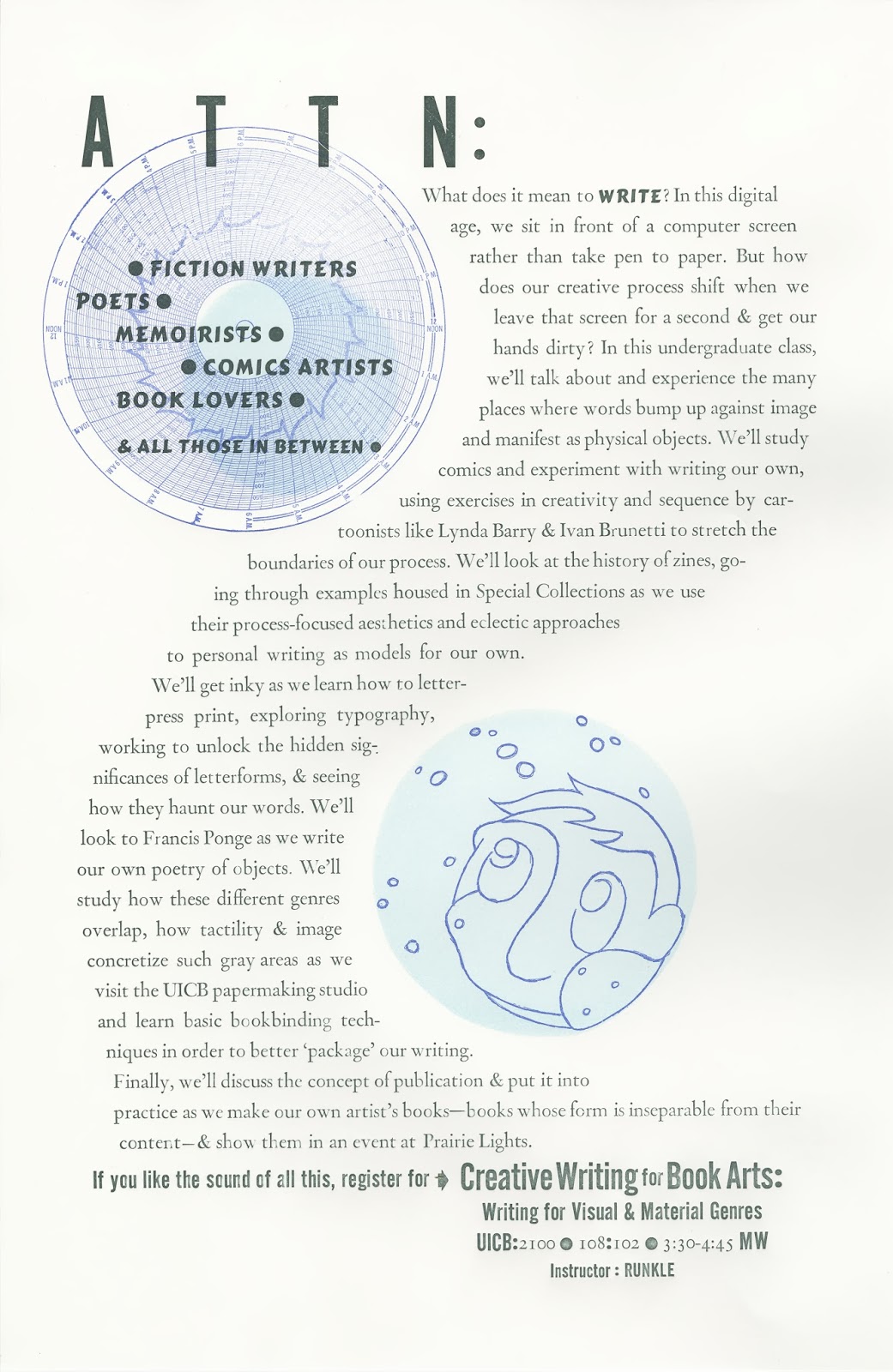
Above is a poster I letterpress printed to promote the class. I used craft foam, a scratch-negative photopolymer plate, a found copperplate block, and metal type (see the lockup below, thanks to Pamela Olson!).

Saturday, August 3, 2013
RUNX TALES #3 now at Quimby's!
 The legendary Chicago bookstore is now stocking RUNX TALES #3 (along with a lot of other awesome stuff). Learn more here . . .
Friday, July 12, 2013
Zine Librarian (un)Conference this weekend
conference_logo_grayscale.jpg)
I had fun designing the logo for the Zine Librarian (un)Conference happening this weekend in Iowa City. Now in its fourth year, the event uses an unconference format to explore issues around maintaining accessible collections of zines.
Monday, November 26, 2012
Down to the wire . . .
Only one week to go to help print RUNX TALES #3! Spread the word!
Check out this new video I made for the campaign, with the help of woodworker/dramatist/silver drummer girl, Jessie Smith. Click here to see the campaign!
Thursday, July 19, 2012
Sarah McCarry on Messiness
Hey, look! I interviewed Sarah McCarry over at SFCB Blog. Sarah—who is creator of Glossolalia (zine), the mastermind behind The Rejectionist (blog), and author of All Our Pretty Songs (forthcoming novel)—is an old pal, and it was great to catch up. She also works as Presse Manager at Ugly Duckling Presse, a publisher dedicated to incorporating handmade elements into the titles it releases. Sarah dishes up the inside scoop on UDP, as well as the dirt on her own life as a writer/blogger/zinester/letterpress printer.
Friday, May 11, 2012
RUNX TALES #3 Preview!

Friday, April 13, 2012
Sneak Peek at RUNX TALES #3!

Friday, March 9, 2012
The Business of Staying Alive.3: Chat-pocalypse with Kyndall Mason

Kyndall and I both live in medium-sized American cities now and mostly keep in touch via online chatting. As natural (and man-made) disasters keep hitting harder and faster, and political forces seem bent on world annihilation, our chats often veer into planning for the worst. Sometimes we fantasize about setting up post-apocalyptic housekeeping in eastern Oregon. When Kyndall had the idea of organizing our chats into some sort of zine, I thought it might be good to test them out as part of The Business of Staying Alive series. Since Google probably already has all our chats filed away somewhere, I figure there’s no harm in letting the rest of the world see them too.
me: old people keep telling me how important it is to have kids so you have someone who gives a shit about you when you get old. it freaks me out. i'm hoping either the world ends first, or i die by 70, or i have enough good friends around who are still alive so we can form some sort of old folks' commune
kyndall: yes! i sort of have dreams about an old folks home for myself and friends. maybe at my grandparents’ homestead in e———!
me: yes! let's do it.....do you think the world is ending soon?
kyndall: no. unfortunately. we will just get to watch it get worse. but not end
me: yeah, you're probably right. i wonder how high ocean levels will be when we're old. e——— might be a good place to be
kyndall: oh, it will be perfect. i think north portland will be ruined by the river, but the coastal cascades will save most of it. then eventually even portland will be under water. but we will be totally safe in e———, and by then the climate will change and will have perfect long growing seasons (my grandma told me most of this btw)
me: yes! your grandma sounds rad. do you think we'll have to arm ourselves?
kyndall: they have guns. but we should get more, just in case. and ammo. i feel like apocalyptic planning is on regular rotation for our conversations
me: ha!
kyndall: you should just make a block print zine with all our gchats
me: yes!!!!! but then everyone will know our plans. it sounds fun, kind of, like coming full circle and ending up back in the inland nw and having to shoot rednecks to protect our crops
kyndall: i'm down! gays get their revenge, finally
me: is there a good water source?
kyndall: yes! there are little creeks that run all through the valley
me: they run all year?
kyndall: there is a glacier lake that is more than 200 meters deep and tons of little lakes in the mountains. yeah! all year!
me: it sounds so nice there
kyndall: some spots they are more than 20 feet wide. it's amazing. here’s a picture of the view from my grandparents' porch:

me: DANG!!!!! I want to be there right now
kyndall: right? i haven't been there since the summer i moved to Pittsburgh. and it's awful, i have been there every summer since i was a kid and then sometimes in the winter too
*****
me: how often do you think about death?
kyndall: um, well, a lot of young people died around me when i was in high school, so in my early 20s, i thought about it a lot. but now i feel like i mostly think about how short life is, or can be. i just don't want to burn to death. what about you?
me: i think about it a lot. do you have a disaster kit?
kyndall: no. like batteries and water and shit?
me: yes. i want to interview people about emergency preparedness. there's this book called thinking in an emergency by elaine scarry where she talks about how people are deliberately kept ill equipped for and uninformed about disasters, so that the powers that be can make us feel unsafe and limit our rights
kyndall: i would buy that. the only thing i feel like i should have is water. the rest i would kill for or steal. if shit really went down i would drive my car as far as i could, then hop a train to my grandma's house. what would you do? i know we talked about meeting at my gma's but if there was like a major earthquake or something and shit was crazy there?
me: hmmm, i would def try to get out of town. that would be my first priority. i do have a lot of water and canned food and 5-gallon buckets full of tools and toiletries and matches and stuff
kyndall: buckets? how many buckets? you gonna just carry a bunch of buckets with you as you walk out of town? or are you just going to put it in a backpack?
me: hmmmm, me and d——— each have a bucket. they are good to shit in if the plumbing isn't working. i also have a large waterproof backpack to be mobile with
kyndall: why don't you just shit outside?
me: in the city?
kyndall: yes. do you really want a bucket full of shit in your apartment? i mean where are you going to put the shit?
me: ummm it's obviously a temporary solution
kyndall: i'm thinking long term here. like where does the shit go?
me: ok, ok, i'm sure we would figure it out. i’m just thinking if there was crazy chaos outside, i wouldn't wanna be shitting out there. also, i don’t have a backyard
*****
me: so do you have a disaster kit right now?
kyndall: no, i just think about how i should have one all the time
me: what would you put in it?
kyndall: water, first aid kit, some kind of weapon, batteries, flashlight, rope. i should probably have some kind of freeze-dried snack too
me: i need to re-stock mine. it has energy bars that have probs gone bad by now
kyndall: do you think they go bad? i mean it's hardly real food
me: true. they have exp dates tho
kyndall: everything has exp dates. just so they can get you to buy new shit
me: true. i stockpile cans of beans too. like a mormon
kyndall: so like a mormon. i have some homemade canned fruit, which i am afraid to eat. what about spam? i bet that would be like a delicacy during the apocalypse
me: totally. i feel like i've been kind of remiss in thinking about morale boosters. i haven't put any booze in because i feel like I will want to be able to think on my feet
kyndall: are you kidding me?! you will want some booze
me: i know. i'm delusional
kyndall: and weed. maybe you should put drugs in there that you have never tried, just so you can try them once things start getting really bad
me: uh. that sounds horrible
kyndall: yeah, it does. the last thing i would want to do is shoot up when the world is ending. but i would probably want a drink and a joint
me: oh yeah. well, maybe opiates would be okay if i knew everything was fucked. i was just thinking of hallucinogens
kyndall: oh, yeah, i would never want to hallucinate
me: what other kinds of seemingly superfluous things do you think it would be nice to have?
kyndall: tampons, toothpaste
me: you think those seem superfluous?
kyndall: tampons are, i think. i suppose i should switch to the diva cup. i would like cheetos puffs
me: those shits will keep FOREVER!
kyndall: i know! and i love them soo much. way more than regular cheetos
me: ha! maybe in a pinch you could use them as tampons
kyndall: you are NASTY
me: sorry
kyndall: it's funny though
me: they seem absorbent, right?
kyndall: no. they don't. when you suck on them, they melt
me: ew
kyndall: you still think i should use them as tampons
me: uh, no
kyndall: what kind of treats do you want in your disaster box?
me: hmmmmm. weed seems like a good one. paper and pens!!!! i need to put that in there. warm socks?
kyndall: warm socks is a really good idea. paper and pens would be pretty good. that's the sort of stuff that i would forget about and spend most of my time looking for during total destruction
me: money! small bills. and maps
kyndall: maps, yes. good one. so.......how big is a disaster box supposed to be?
me: i think it's relative. it's probs better to have several throughout your house. like a couple more stationary stashes with gallons of water, etc, but also a bag or something filled with supplies that would be easy to pick up and carry if you needed to leave in a hurry. someone told me it's better to spread supplies throughout your house in case part of it collapses. then you're screwed if everything is in one place and it becomes inaccessible
kyndall: damn, i never even thought about stashing shit all over the house. that's a good idea. where would you go if you had to leave in a hurry? i mean in the immediate, not long term location
me: emergency shelter. or who knows why you might suddenly need to leave town?
Wednesday, February 22, 2012
History of the Book.3
Continued from Part 1 and Part 2


For various reasons, that “summer trip to the West Coast” has now lasted seven years. I’m surprised those books I made years ago have survived like they have, considering how much I did not know what I was doing. Of course, it didn’t hurt that I was salvaging from more solidly assembled structures. But still.
Which leads me back to that space between the second and third dimensions, and the challenge of addressing it in a venue as seemingly flat as, say, a blog. Because this is where I’ve been channeling that energy—once reserved for dissembling and mashing up longer-form, structural narratives—into compressed one- and two-shot collages.* There are a couple of reasons for this:
1. My attention span has waned, what with the Internet and all that. I try to fight it in some arenas, but since the blog is a medium suited to quick little glimpses, I figure this is one battle not to pick. Also, I finished writing a novel last year, and since then, most things I do—whether writing (flash fiction) or art (collage as blog posts)—want to be microcosmic.
2. Binding kind of stresses me out. I love the results: a sturdiness that allows for shifts as you turn the page. But there’s a commitment there that’s scary. Besides, I’ve never really gotten the math down.
So there is a kind of liberation in the blogged collages, in that they are both low commitment and ephemeral. I can knock one out in an evening if I want, and I don’t have to worry about it lasting. Once I’ve placed it in the scanner, and made sure any wayward details are straightened, I can shove it in a milk crate and forget about it. If for some reason in the future, I try and dig it back out to hang on a wall, and it crumbles in my hands, I’m okay with that: I’ve prepared myself. Anything that survives is—if not a miracle—a bonus.

Because all that matters here is the scan, those few crucial seconds after the lid closes when the light cranks by. And here’s where it’s hard not to think of the scanner as a book. Its design seems modeled after the codex, doesn’t it? And it “reads” the things you put inside it, a fleeting act that ends up feeling kind of like a fossil record. A mummification in the ether. An anti-binding, maybe? Or at least a binding that takes place in some unnamed dimension.
There is a whole genre of scanner art, I’ve discovered, called scanography (scannography) or scanner photography—where images use the technology of the scanner in their composition. Just as zine aesthetics (and Xerox art) came about through the advent of the photocopier, the accessibility of the scanner has created an aesthetic of its own.

One thing I’ve thought about is how zine aesthetics changed a lot when photocopiers digitized and Kinko’s became harder to scam. As zine makers have focused more on using pre-Xerox printing techniques, such as silkscreen and letterpress, there seems to be less of an emphasis on the textural nature of collage. This makes me wonder about the future of the scanner: what might be marketed to take its place? That’s why it’s good, I guess, that I’m trying to become less reliant on—and take take less comfort in—technologies that are ultimately temporary.
The book, though, is not one of those technologies—despite the hand wringing that’s happening with the spread of ebooks. The physical book is becoming increasingly fetishized as it threatens to disappear, and with it, I think, the sense of touch. Although all our coveted devices are sold to us by boasting features such as touchpads and touchscreens, once we step away for a second, we see how flat these things really are. And what about CGI? These “3D” creations would deflate with a fart if you tried to grasp them. A simple line drawing is more dimensional than CGI's special effect placebos. So, yeah, there's my side-rant, and I guess my point is this: there is a longing, I think, beneath all this prognosed dematerialization, for something you can hold in your hands. And that longing is here to stay.
So the neglect I’ve been giving bookmaking lately is temporary. I'll return to it, I promise myself, after I tire of the fun I'm having completing things that can remain incomplete. In the meantime, I like the challenge of trying to bring tactility—or at least the illusion of it—to the often textureless realm of the Internet. I also like the freedom of being able to incorporate three-dimensional elements that I couldn’t in a book whose pages must ultimately lie flat (the scanner's fine with not closing all the way). Who knows? Maybe one day, when blogs are obsolete, I can come full circle and take on the challenge of translating this blog's content into a physical book. How's that for completion?
*I’ve only made a couple altered books since I’ve been on the West Coast: Tarpaulin Kingdom and The Witch, a Lemondrop Wedged Firmly In Her Cheek, Begins Her Evening Prayers.
Friday, December 23, 2011
Letter from Pedestrianica.3
 When I was in my early 20s and at the height of my intellectual hubris, I made a zine. It was called Now It’s All Behind You—appropriate, right, for something you pick up again years later and feel really embarrassed about? The whole thing is vaguely themed around physical space (and by extension, time), from comics about maggot real estate to artsy analyses of industrial displacement in Eraserhead and Daydream Nation. But the feature that’s really stuck around—both for the shame it causes and because it articulates a way of thinking I still haven’t outgrown—is something called the Pedestrian Manifesto.
Have you ever tried to write a manifesto? Well, this was my only stab at it, and I have to say it was kind of fun. I can feel it when I read it today: as cringe-worthy as it is, there’s actually a sort of energy that makes me want to keep going.
I may have been young and dumb, but I was smart enough to take a certain precaution: Irony (after all, this was the late ‘90s; what other stance could I really take?). I knew the other meaning of the word pedestrian, and how at odds it was with the urgency I was trying to create, as well as how perfectly that other meaning described the style of most political screeds. So excuse me while I pat my younger self on the back.
Because there’s A LOT in the Pedestrian Manifesto that’s not so pat-worthy. I make questionable use of quotes from Wim Wenders’s Wings of Desire to advance my argument. I write lines like this: “How can the modern-day walker … waltz drunkenly amid the urban confines of right angles?” My levels of condescension are at an all-time high. I don’t allow for the privilege inherent in walking, and for the existence of physical disabilities. I also don’t get much further than a lengthy introduction before bringing out that lazy old standby: To be continued . . .
But, yes, irony: here you are, just like I knew you would be. Here to represent, to offhandedly deflect my shame. Because I didn’t really mean it!
And because all the while I must have secretly believed I would outgrow this idea.
And thus, irony has rewarded me. Can you blame me then, for the detachment I maintain today, as I pick up where I left off twelve years ago and write these Letters from Pedestrianica? Because it remains something I feel passionate about: The stale, unceasing onslaught of car, after car, after car, after car, after car. I mean this. I do. It’s a feeling I have yet to outgrow.
It’s hard to approach a utopian project without a certain level of ironic distance. Humor is protective. The levels of dysfunction and cruelty are staggering, the odds unbelievably low. I’ve been watching, a little at a time, Chris Marker’s protest documentary, A Grin Without a Cat, and have come away from it pretty discouraged. Patterns are on display here—popular calls for change and resulting state suppression—patterns we’re once again in the midst of repeating. But there is hope still, there in the moment, just before the cops show up with their scowls and their batons. And while A Grin Without a Cat is far from being laughably earnest, its disconnect is not to the extent that it doesn’t mean what it says.
But: By simply envisioning a different world, will it come to fruition? No. Especially if your utopia is as logic-less as mine.
Maybe utopias aren’t meant to physically exist, at least not in the ways they’re first imagined. And perhaps they’re better conjured, anyway, through a series of letters rather than a systematically propagandic presentation of logic. Especially, I guess, for a brain that’s twelve years further frayed.
So this utopia—the one I’ve named Pedestrianica—is a personal place, but it’s not exclusive, and while I’d like to see profound changes in the way we move, I’m not trying to start a movement (or am I?). When it comes down to it, I guess what I’m hoping for is some sort of confirmation I’m not nuts. Perpetually hyperbolic, yes. But not nuts.
Is it nuts to address a letter to a carless nation?
Tuesday, November 1, 2011
Cartoonist in Residence!
 I'm the November Cartoonist in Residence at San Francisco's Cartoon Art Museum! Which means I'll be there this Saturday, Nov. 5, holding court at a drawing table from 1-3 pm. I'll have some comics and zines for sale, and will display the just-finished originals from an illustrated essay memorializing the legendary drugstore, Super Longs. I also hope to get going on some doodles for an interview I did with fiction writer, Jincy Willett. The Cartoon Art Museum is located at 655 Mission Street, between New Montgomery and Third.
Subscribe to:
Posts (Atom)